Friday, June 11th, 2010
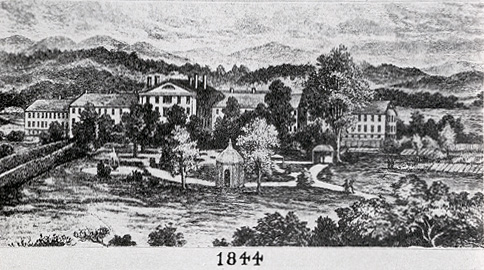
I recently came into possession of a small booklet about the Brattleboro Retreat which was published in 1931. The booklet contains the hospital’s history and lots of photographs, but what I found most interesting was the drawing above. That is, of course, the Retreat’s main building which I would call a Kirkbride (albeit a small and unimpressive one). But notice that the drawing is dated 1844 — a few years before the widely accepted “first Kirkbride building” was designed and built in Trenton, New Jersey! (more…)
Posted in Buildings, Pictures | 5 Comments »
Wednesday, September 9th, 2009
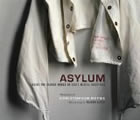
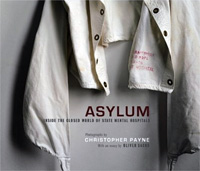 Chris Payne’s upcoming book Asylum: Inside the Closed World of State Mental Hospitals is available for pre-purchase on Amazon. In case you don’t know, Chris Payne has been taking fantastic photographs of state hospitals for many years now. Although we’ve never met in person, our paths have crossed a few times as we both travelled around the country visiting many of the same psychiatric hospitals. Mr. Payne, however, has visited more hospitals and taken more photos than I have—better quality photos too. I haven’t seen a copy yet, but I’m certain this book will be worth purchasing if you have any interest in asylums and asylum architecture. I’ll write more about it after I get a copy to look through. That will probably be some time in early October.

Posted in Books, Pictures | 11 Comments »
Tuesday, March 10th, 2009
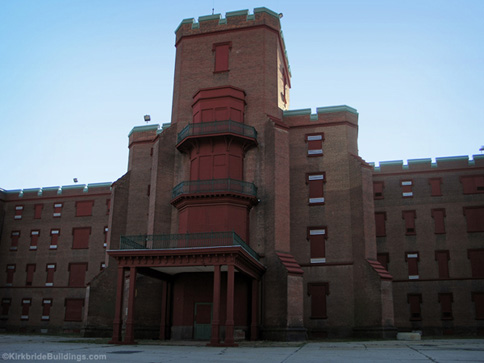
I finally got around to adding a page for the Kirkbride building in Washington, DC: Saint Elizabeths Hospital. I was fortunate enough to get on the DC Preservation League’s tour of the West Campus this past December. Unfortunately, the sun was low on the horizon and behind the building. So the exterior pictures of the Kirkbride’s facade are a bit dark and flat. Oh well. The League may be putting together tours of the campus again this Spring. If I’m lucky I’ll get another chance to take pictures when there’s more light on the front of the building, and more greenery around too.
Even though the Saint Elizabeths Kirkbride isn’t on my list of favorites (I’d even go as far as saying it’s on the ugly side), the hospital campus itself is really beautiful. The view of Washington, DC alone is fantastic. But the variety of trees which fill out the grounds are also attractive and cast some amazing shadows. Then there’s the sense of history you feel when walking around all those old historic buildings on the outskirts of the nation’s capital.
If tours are given again this Spring, I really recommend signing up. There may not be many more chances to see this Kirkbride after the Department of Homeland Security starts transforming the West Campus into its new headquarters. Most likely, you won’t get to see the inside of the Kirkbride on the tour, but walking around the campus is interesting enough and won’t cost you anything either. If I hear anything about the tours, I’ll mention it here. So stay tuned.
Posted in Buildings, Pictures, Web Sites | Comments Off on Saint Elizabeths Hospital
Friday, November 28th, 2008
Note: Sadly, the photos linked to in this blog post are no longer online.
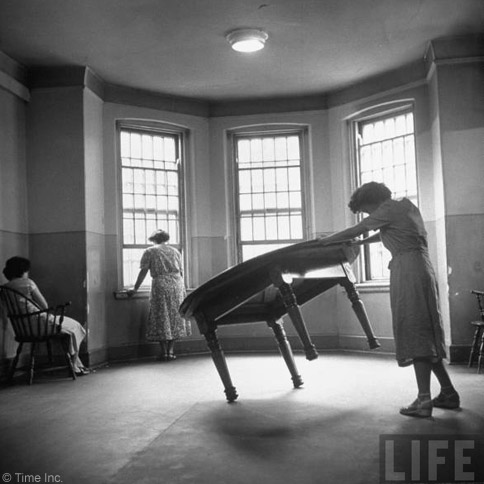
Google and LIFE Magazine recently arranged a deal whereby LIFE’s vast photo archive will be placed online. You can find a portal to the collection here. What I really want to draw your attention to though is a handful of images taken by photographer Herbert Gehr at a mental hospital in Worchester [sic], Massachusetts in 1949. One of these photos (reproduced above) leaves no doubt that they were indeed taken at Worcester State Hospital. Anyone that’s been inside the Worcester Kirkbride will recognize the space in which three women create this somewhat surreal scene.
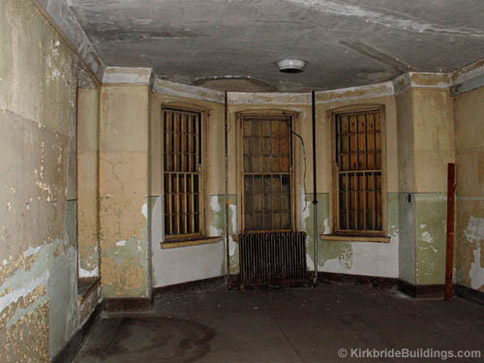
I don’t think all the photos in this collection were taken inside the Kirkbride, but I believe most of them were. They’re really a pretty fascinating group of images too—some are slightly bizarre, some are disturbing, and others are hauntingly beautiful. It’s weird to see that the basement almost looked creepier in use than it did after it was abandoned. Below are links to all the pictures. (Note that you can view a larger version of each image by clicking the “View full size” link on the image page.) (more…)
Posted in Buildings, Pictures, Web Sites | 7 Comments »
Monday, November 24th, 2008
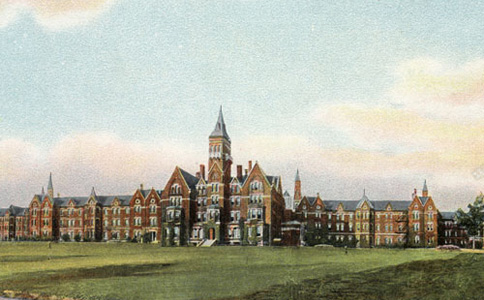
Things have been really slow in Kirkbride news lately. While there have been some minor developments, they’re really nothing new, definite or exciting—just incremental changes in the status of a few buildings. I haven’t been creative enough lately to come up with posts in spite of that lack of activity too, so I have to apologize again for the lack of new information here lately. When I started the blog I planned on posting once a week. Until now, I actually managed to do that—surprising since I half expected to run out of things to post about after a few months.
Anyway, for the lack of anything better to post, I thought I’d point you to a collection of Kirkbride building desktop wallpaper. The backgrounds are mostly old historical images we’ve all seen before, but here they’re nice and big to fit on your computer desktop. Enjoy.
Posted in Buildings, Pictures, Web Sites | 1 Comment »
Friday, September 19th, 2008
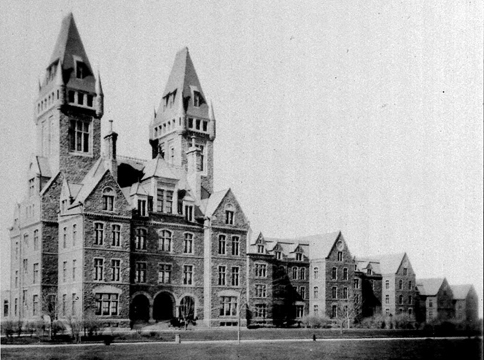
Yesterday, Richard Nickel, Jr. over at The Kingston Lounge posted about the Buffalo State Hospital Kirkbride. Along with a nice write-up about the building, he included some first-rate photos of the Kirkbride’s interior, something my own site is still sorely lacking:(
It’s worth checking out, and you can do so here: BSH – The H. H. Richardson Complex.
Posted in Buildings, Pictures, Web Sites | Comments Off on The Kingston Lounge Presents: Buffalo State Hospital
Monday, September 8th, 2008
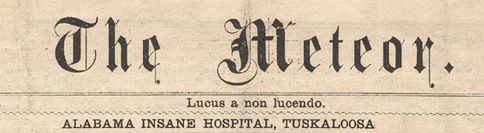
Our little paper, gotten up for the benefit of the patients of the Alabama Insane Hospital and to give the patrons of the institution an insight into some details of its practical operations, is printed on quarto Novelty Press, without expense to the State—the whole labor of type-setting and putting to press being performed by the patients, or by employees of the Hospital in intervals of leisure from their regular duties…
That’s how The Meteor—a newspaper written and published by Bryce Hospital’s patients—describes itself in its inaugural issue published in 1872. The Alabama Department of Archives and History has put eleven issues of The Meteor online in PDF format (note that at the time of this writing the link for the second issue isn’t working). While not quite the juicy rag you might hope for, the paper’s articles do offer some glimpses of life at the hospital as well as into the minds of the patients.
My favorite part is from the very first issue where one patient compares Alabama’s hospital for the insane with its neighbor the state university by saying, “The inmates of the University come to acquire ideas. We to get rid of them.” (more…)
Posted in Buildings, In the News, Pictures, Web Sites | 1 Comment »
Tuesday, August 19th, 2008
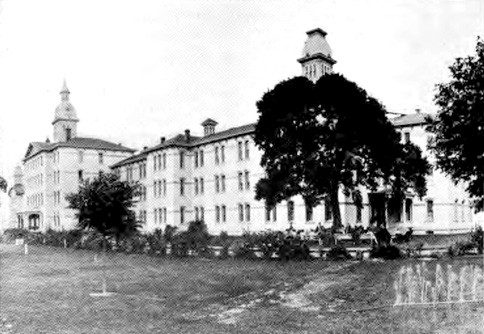 As a result of the site’s 15 minutes of fame a couple weeks ago, I got a few emails about Oregon State Hospital. Each made a case for including the Oregon State Hospital “J Building” (soon to be “The Kirkbride U“) in my list of Kirkbrides. They were pretty convincing I have to say. Apparently the building was originally designed according to Kirkbride’s specifications, but when it came time to add on additional wards, real estate issues prevented the wings from being extended in the normal fashion. Instead, they were extended back at a right angle to the original building’s main axis.
After hearing the evidence from multiple sources, I’ve decided to finally consider the building a Kirkbride. I’m a little worried that adding it to the list will open the door to other variants and ugly cousins of the Kirkbride plan, but we’ll see. (Just to be clear, I don’t mean to say that OSH is ugly:) I also got a bunch of messages about other possible Kirkbride buildings not included in the list. Some people were obviously just mistaken, but a couple submitted promising candidates. I’ll keep you posted if anything interesting turns up. (more…)
Posted in Books, Buildings, Pictures, Web Sites | 12 Comments »
Thursday, August 14th, 2008
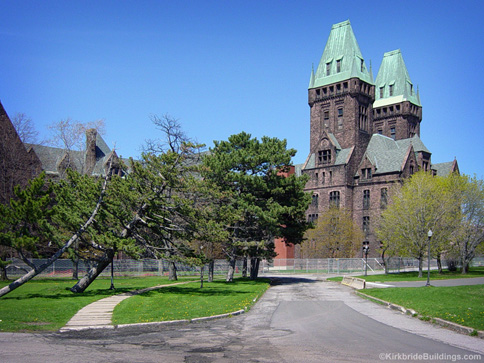 On Tuesday there was a public meeting concerning efforts to preserve the Buffalo State Hospital Kirkbride. At the meeting, the Richardson Center Corporation revealed their Historic Structures Report (available for download on their documents page). The report is a beautifully comprehensive collection of history and images of the hospital buildings, and you should definitely check it out.
I haven’t digested the whole report yet, but the part I find most interesting so far is the description of the hospital’s construction, development and eventual downsizing which begins on page 62. Included are maps of the hospital campus during different time periods, as well as photos of the buildings from over the years. Especially striking is an old photo from about 1880 of the unfinished Kirkbride (page 70). (more…)
Posted in Buildings, In the News, Pictures, Preservation | 2 Comments »
Monday, July 21st, 2008
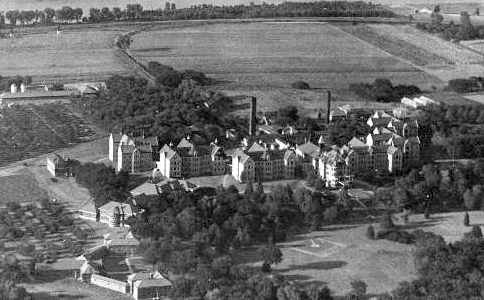 I got an email last week informing me that my list of Kirkbrides was incomplete because the asylum in Osawatomie, Kansas wasn’t included. While I’m still not 100% sure there was a Kirkbride there, I trust this person‘s opinion and went looking (again) for whatever evidence I could find.
During my search I did find something promising related to the Osawatomie asylum, but the thing I found really exciting was something else entirely that I stumbled upon by happy accident. I’m sure only the most geeky of asylum architecture enthusiasts will find this interesting, so if you’re not one of those, please disregard this post. If you are an asylum architecture nerd, then read on… (more…)
Posted in Buildings, Pictures, Web Sites | 14 Comments »